I'm Nicola Plaisant.
Founder and design leader based in Berlin.
SumUp
Principal Product Designer | 2020 -2022
SumUp is a financial technology company that provides mobile point-of-sale solutions. SumUp's mission is to empower small businesses by making it easier for them to accept card payments. Its flagship product is a small card reader that can be connected to any smartphone or tablet via Bluetooth. In addition to its card reader, SumUp offers a range of other products and services for small businesses, including invoicing software, online payments, and cash advances. Its products are designed to be user-friendly and accessible to businesses of all sizes, from sole traders to larger companies.
Led several projects including: new registration flow, ID management, Web App new navigation...
Released new developer portal and self-serve interface during a 4 days Hack Week.
Facilitated many workshops, up to 30 stakeholders. New service blueprints for banking, CRM, growth.
Managed one direct report.

Contributions
As a Principal Designer in SumUp's platform team, I played a crucial role in cross-organizational initiatives aimed at improving the overall user experience. My responsibilities included full-stack design and facilitation, which involved conducting complex flow and use case analysis, user research, and finalizing designs. Additionally, I conducted workshops with over 30 stakeholders to align on experience quality, customer satisfaction, and business goals. Through my efforts, I helped drive a holistic view of the user experience at SumUp.
Case study: releasing a new navigation
Changing a product navigation is challenging due to the complexity of the existing structure, user familiarity with the current system, the need for consistency across different platforms, technical implementation considerations, testing requirements, and aligning stakeholders' perspectives and priorities. Careful planning, user research, iterative design, and effective communication are essential for a successful navigation change.Throughout my career, my primary focus has been on developing tools and applications that enable individuals to efficiently complete their tasks and concentrate on what truly matters.
During my tenure at SumUp, I faced the challenge of launching a new navigation system for the web dashboard, serving four million merchants, despite lacking the proper infrastructure for AB testing. We tackled this challenge through qualitative testing with prototypes, adhering to best practices, and taking calculated risks.Our approach was rooted in the belief that progression should take precedence over perfection. I firmly believe that by deeply empathising with your customers and understanding their pain points, you can drive rapid progress and deliver value, even in less-than-ideal conditions.
I led this 3-months project and shared my learnings with the greater company as well as with the UX community in Berlin in a meet-up organised by Tech Circus.

New registration and onboarding flow
Another area of responsibility was to oversee a new identity experience for our merchants as well as an improved registration and onboarding flow, as we had churning problems for merchants that didn't yet purchased a card reader and were looking for other services.We had to improve how we explain benefits and requirements, as well as making it easier to start, pause and complete the flow taking into consideration our merchants context of use.


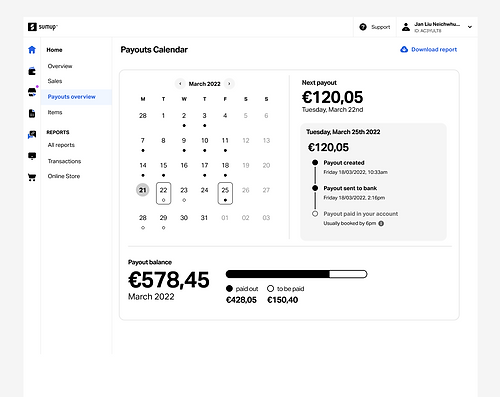
Payout Agenda
It can be challenging to fully understand that for small business owners, success isn't just about personal fulfillment; it's often a matter of survival and providing for their extended families. The most pressing concern for these merchants who rely on digital payments is often when they will receive their next payout.

Facilitating decisions
In the role of a Principal Product Designer, facilitating decisions is essential. In remote workshops with a large number of participants, several challenges arise, such as diverse perspectives and decision fatigue. To address these challenges, specific artifacts and approaches are needed:
1. Clear agendas and goals should be defined to set the workshop's purpose and objectives.
2. Structured facilitation processes help ensure equal participation and efficient decision-making.
3. Visual documentation using tools like virtual whiteboards or sticky notes captures and organizes ideas and decisions in real-time.
4. Design artifacts such as wireframes or prototypes aid discussions, concept validation, and iterative ideation.
5. Decision frameworks outline evaluation criteria and options, assisting participants in systematically assessing alternatives.
6. Prioritization techniques like dot voting or impact-effort matrices facilitate collective decision-making.Documenting outcomes, decisions, and action items ensures clarity and serves as a reference.
7. Regular check-ins throughout the workshop maintain alignment and address questions.
Starting the project the right way is also a fundamental skill to practice. I find useful that, before people start to look at competitors and designers start sketching, the team has the chance to start and align on a simple document. Take a look and let me know what you think...

